

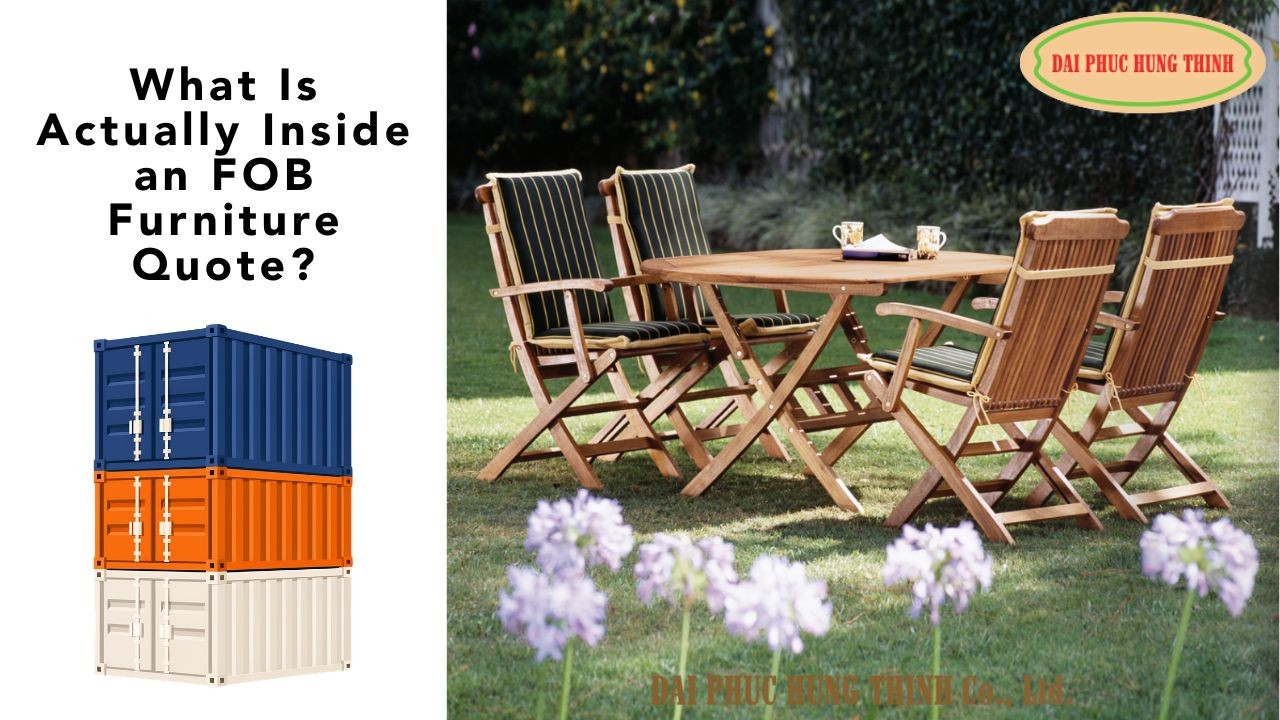
An FOB furniture quote is the price of your goods delivered onto the vessel at the port of export, with export clearance done. Inside that number sit five things: timber, hardware, finishing, packaging, and loading. When two quotes for the same drawing come back 18 percent apart, the gap is almost always hiding in one of those five, not in the supplier's margin. This post walks through each one so you can compare quotes line by line instead of guessing.
What FOB covers and where it stops
Under Incoterms 2020, Free On Board means the seller carries cost and risk until the goods are on board the vessel at the named port of shipment. Export customs clearance is the seller's job. Everything after that point, ocean freight, insurance, import duty, customs clearance at destination, and inland delivery to your DC, is yours.
That matters when you compare an FOB number with a CIF number. CIF looks higher on paper because it has freight and insurance baked in. Neither is cheaper. They just stop at different points. Always confirm which port is named, because FOB Ho Chi Minh City and FOB a smaller regional port are not the same cost base.
Timber: the biggest single line
For solid wood outdoor furniture, timber is normally the largest cost in the quote. A few things move it:
Species and grade. FSC certified acacia and eucalyptus are the workhorses of European outdoor programmes. Within one species, grade matters more than buyers expect. A tabletop that allows small sound knots costs less than one specified clear and defect free, because the yield from each cubic metre is higher.
Yield loss. Wood is bought in cubic metres and sold as finished parts. Kiln drying, planing, ripping out defects, and finger jointing all consume volume. A 45mm thick slat that finishes at 40mm has already lost material before assembly. Ask what net-to-gross yield a supplier assumes. Suppliers who quote a low timber cost sometimes assume yield they will not hit, and the shortfall shows up later as a price revision or a quality drop.
Moisture content. Outdoor furniture for Europe is normally kiln dried to a controlled band. Drying costs energy and time, and it is also the single best defence against warping and mold in transit. A quote that beats everyone else's by a wide margin is worth checking here first.
Certification. FSC chain of custody is not a sticker. It is an audited system that tracks certified material from the forest through every processing step, and it carries real administrative and material cost. If a quote is FSC and another is not, you are not comparing like for like. If a supplier claims FSC, ask for the licence code and check it yourself on the FSC public database. Ours is C009028.
Hardware: small parts, large consequences
Hardware is a modest share of the quote and an outsized share of returns. Outdoor furniture lives in rain. Carbon steel bolts rust, streak the wood, and generate complaints in the first season.
The usual choices are zinc plated steel, A2 stainless (304), and A4 stainless (316). A4 handles coastal and salt exposure best and costs the most. If one quote specifies A2 and another says only "stainless", you have found part of your price gap. The same applies to extension mechanisms, folding hinges, and umbrella hole fittings on tables. Specify grade and finish in the tech pack, not in the email thread.
Finishing: where two identical chairs stop being identical
Finishing covers sanding, staining or oiling, and any protective coat, plus the labour for each pass.
Sanding grit and the number of passes drive both the look and the price. So does the finish itself. A single dip of oil is cheap and gives a soft matt look that greys over time. Multiple coats with sanding between them cost more and hold colour longer. Neither is wrong, but the customer-facing story is different, and so is the return rate.
Ask specifically: how many coats, applied how, dried how long, and what does the supplier's own colour reference look like under daylight. Colour drift between production runs is one of the most common complaints in wooden outdoor programmes, and a signed master sample plus a retained reference at both ends is the fix.
Packaging: the line buyers cut first and regret
Packaging protects the piece through port handling, a long ocean leg, a DC, and often a home delivery. On a knocked-down programme it is also the piece the end customer physically interacts with first.
The variables are carton board grade and wall count, inner protection such as corner guards and foam, poly bagging against moisture, the desiccant load, printing, and whether the goods ship on pallets. Every one of those has a real cost, and cutting any of them saves cents and risks a damage claim worth far more.
Two questions worth asking every supplier: what board grade and edge crush test rating are you quoting, and has this carton been drop tested. Vague answers here are informative.
Loading: what fits and who pays for the last metre
The last piece of an FOB quote is getting the goods into the container and onto the ship. That includes trucking to port, terminal handling on the export side, export documentation, fumigation or heat treatment of wood packaging where required under ISPM 15, and the labour to load.
Container fill is where the real money is. A 40ft high cube gives roughly 76 cubic metres of internal volume, and in practice a well planned load uses somewhere in the mid to high 60s once carton shapes and stacking limits are respected. Every cubic metre you waste is freight you pay for and do not use. This is why knocked-down construction changes the maths so much, and it is the subject of the next post in this series.
How to compare two quotes properly
Put both quotes on one page and force each supplier to state, per item: species and grade, moisture content target, certification and licence code, hardware grade, number of finishing coats, carton spec, pieces per carton, carton dimensions, and units per 40ft high cube. Add the named port.
Once those lines are visible, the cheaper quote is either cheaper for a reason you can accept or cheaper for a reason you cannot. Both are useful answers, and neither is visible from the FOB number alone.
Frequently Asked Questions
Does FOB include ocean freight?
No. FOB ends when the goods are on board at the named port of export. Freight, insurance, and import costs are the buyer's.
Why do FOB quotes for the same drawing vary so much?
Usually timber grade, moisture content, hardware grade, number of finishing coats, or carton spec. The drawing is rarely the variable.
Is FSC certified acacia more expensive?
Yes, certified material and audited chain of custody carry cost. The comparison only makes sense against another certified quote.
How can I check a supplier's FSC claim?
Search the licence code on the FSC public certificate database. If a supplier cannot give you a code, treat the claim as unverified.
What should I ask for alongside the price?
A packing specification with carton dimensions and units per container. Without it you cannot calculate landed cost per piece.
About Dai Phuc Hung Thinh Furniture
Dai Phuc Hung Thinh Furniture has been building outdoor wooden furniture since 2003, which makes us one of Vietnam's most experienced garden furniture suppliers. We work in FSC certified acacia and eucalyptus, and we supply furniture retailers across Europe.
Most of what is in this post comes from quoting these programmes year after year and seeing where buyers get caught out. If you are comparing quotes for an upcoming season and want a second opinion on the line items, we are happy to talk it through. Email us at william@daiphuchungthinh.com.